

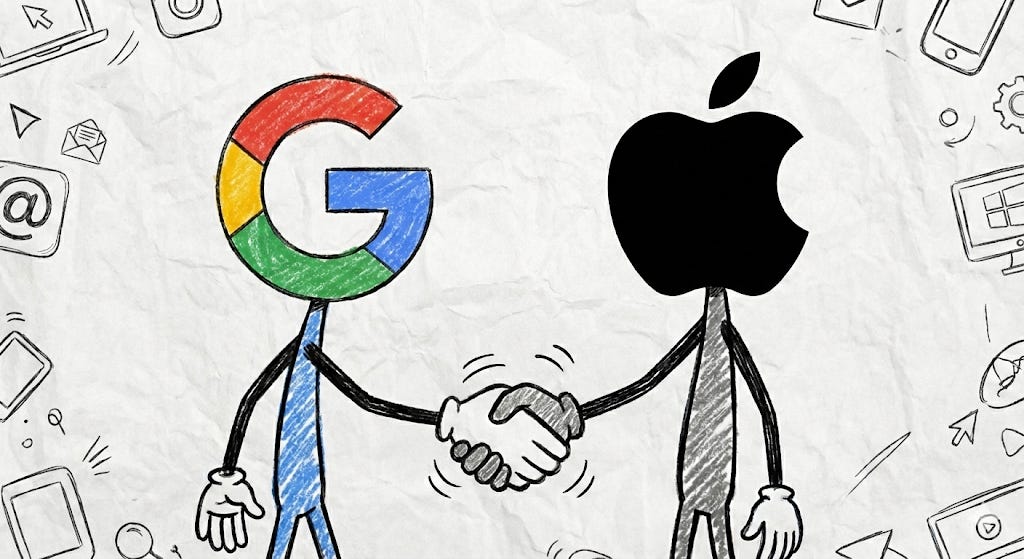
The recent confirmation of Apple integrating Google’s Gemini into the “Apple Intelligence” ecosystem is a Rorschach test for the industry. Depending on how you look at it, this is either a concession of technical leadership or a very interesting capital allocation move.
The reality is likely both. This deal signals a shift from vertical integration at all costs to a pragmatic, hybrid approach. Let’s dissect the decision through two distinct lenses: the architectural reality and the financial logic.
The engineering audit: the hybrid stack
Apple has effectively decoupled inference from training. By partnering with Google, they acknowledge that while they lead in silicon efficiency (inference), they lack the infrastructure for massive-scale model training. The resulting architecture is a complex, three-tiered system.
1. The on-device router (Edge)
The first layer of defense is local. Apple is running quantized, 3B-7B parameter models on the device (iPhone/Mac).
The mechanism: a semantic router evaluates every user query in real-time. If the request is personal (”Play my workout playlist”), it stays local. If it requires world knowledge (”Draft a travel itinerary based on this email”), it routes upward.
The engineering win: this keeps latency near-zero for 90% of daily interactions and preserves battery life by not firing up the radio for every token.
2. Private cloud compute (the middle layer)
This is where Apple did innovate. Rather than simply piping data to Google Cloud, they built an intermediate layer: Private Cloud Compute (PCC).
Hardware: Apple filled server racks with M2 Ultra and M4 Ultra chips. This creates a “stateless” cloud environment.
Security architecture: unlike standard Linux servers where root access offers broad visibility, these servers use the same secure enclave logic as an iPhone. Data is encrypted, processed in memory, and cryptographically destroyed upon completion. There is no persistent storage of user data.
The function: It acts as an anonymizing proxy. It strips personally identifiable information (PII) before the query ever touches Google’s servers.
3. The inference backend (Google Gemini)
For the heavy lifting, Apple hits the Gemini API running on Google’s TPU v5p clusters.
The bottleneck: the risk here is purely network physics. The round trip (device -> PCC -> Google -> PCC -> device) introduces multiple hops. Orchestrating this without user-perceptible latency requires aggressive pre-fetching and optimized interconnects between Apple’s data centers and Google’s regions.
The financial audit: CapEx efficiency
While the engineering team manages the latency, the finance team is managing the margins. From a balance sheet perspective, this deal is a defensive masterclass.
1. Avoiding the "CapEx Cliff"
Building a frontier model capable of competing with Gemini or GPT is not just hard; it is very expensive.
The alternative cost: developing a proprietary "AppleGPT" would require $20B-$30B in immediate infrastructure spend (data centers + NVIDIA H100s/B200s), plus ongoing energy costs.
The "rent" model: by licensing Gemini for an estimated ~$1B/year, Apple converts a massive, depreciating capital expenditure (CapEx) into a predictable operating expenditure (OpEx). This protects Apple’s gross margins and frees up cash flow.
2. The upgrade supercycle
Apple’s business model is selling hardware, not search ads. This integration is the feature set required to drive upgrades.
Hardware requirements: the local models and secure handshake protocols require significant NPU performance and RAM. This likely renders older iPhones (pre-iPhone 15 Pro) incapable of running the full suite.
The strategy: by raising the system requirements, Apple forces a refresh cycle across its massive installed base. The software is the lure; the hardware is the catch.
3. Commoditizing the intelligence
Apple is effectively treating the LLM as a commodity component, similar to how they treat memory modules or display panels. They don't need to make the screen, they just need to ensure it meets their specs. By using Google (and leaving the door open for OpenAI), Apple prevents any single AI provider from having leverage over them, maintaining control of the user interface—and the customer relationship.
Summary
The “Apple + Google” alliance is both a surrender and an architectural pivot. Apple has recognized that training foundation models is a low-margin, capital-intensive utility, while deploying them is a high-margin differentiator.
They have offloaded the heavy lifting (and the depreciation costs) to Google, while retaining the privacy layer and the hardware profits for themselves.
Sources: